Showing posts with label Medical Research. Show all posts

Friday, September 6, 2013

A Reflection From A Medical Writer


I have arrived, yet another day at work as a medical writer...I sit down at my desk, prioritize my deadlines, and turn on my computer eager to uncover the answers and find the words to help improve the health outcomes of others.
 
I have 8.5 hours to educate patients about a novel treatment option for their recurrent brain cancer; parents about a medicine that can help their babies breathe as they lay helpless in the NICU; and young children about the risks of high blood pressure and what it means to take part in a clinical trial. Is this possible?  I often come across as overwhelmed, which I am, but overwhelmed with anticipation as I contemplate how each of these audiences will respond to the content I reveal about their condition. I read through the clinical data, the published journal articles, and prescribing information. I struggle to find the patient-friendly, yet clinically accurate terms that will communicate each of these disease states and treatment options. I have an important job.

Each and every day I am tasked with finding common ground between brand objectives; medical, legal, regulatory reviews; financial scope; healthcare provider initiatives; and the needs of patients and caregivers. Who is my audience I ask? How can we all benefit from the words I choose to educate about a specific condition or treatment? How do I empower patients in one sentence, yet tell them to always talk to their doctor in the next? There are so many considerations, so many consequences to take into account and I think to myself, is it possible to adhere to my true purpose and passion in life...to motivate patients to take control of their health.

My contemplation becomes an affirmative reality when months later I walk into my OB/GYN's office to see my words explaining the menstrual cycle posted on the wall. And when I hear the nurse educators describe the positive impact of a teaching easel I wrote about brain cancer and the success of a diabetes book for kids encouraging them to make healthy choices that went digital. The many hours of researching, writing, and collaborating with my colleagues and clients pays off. 

I am not alone in my motivation to help others. I work with a team of very passionate and dedicated people who discuss, develop, and design the most impactful patient and professional education with the end-user in mind. My words are only the beginning. I am amazed by what transforms with the artistic insight of our graphic designers, medical illustrators, and medical animators. My words come to life. Together we tell a story. A story that is accurate, insightful, and inviting. A story that will make a positive difference in the lives of others. 

All in a day's work!

Lynn Altmaier, BS, BSN, RN, MSc
                                                                                                                  Senior Medical Writer at AHE

Thursday, August 8, 2013

The Fall of Independent Practices and Practitioners


Samantha Reba
Junior Writer

Most doctors take pride in owning their own practice and being independent employers. They view hospitals as institutions where they extend care to their patients. Not as a place of employment. But as the healthcare climate changes many physicians are foregoing the independent route and becoming hospital employees.


 The only way that independent practices are going to survive is if:


  •    They’re exceptional in their field of work or one specific field (ie, gynecology or dermatology)
  •      They can keep up with new, cutting edge technology and practices
  •        Maintain their names and practice outside of hospital walls.


The main problem that is targeting independent practices is the lack of specialists that are willing to join the ranks of a practice outside of a hospital. Without these specialists, these independent practices are going nowhere fast, while hospital staff is growing.


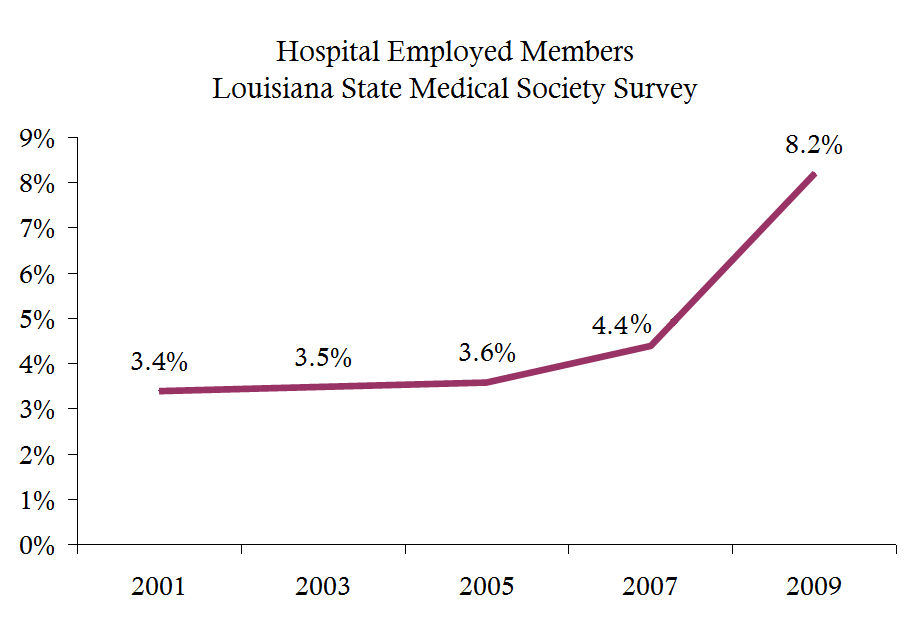
Today, less than half of doctors in the United States own their own practices. This is due to the cost of maintaining a practice and still being able to generate a profit at the end of the day.

“Last year, 47 percent of physicians in the U.S. were employed by hospitals – roughly twice the percentage in 2002.” Surveys by the Medical Group Management Association.

This percentage is drastically increasing each year.

Additionally, doctors are finding it hard to find a balance between their work and personal wellness. There are so few doctors in practices because with two or less doctors on site, doctors are taking on increasingly more patients, which not only increases stress but also decreases personal wellness. A downward cycle starts of increased stress and decreased personal wellness resulting in an independent physician no longer able to keep up with a practice. 

The decline in independent practitioners affects other healthcare services; independent laboratories for one. With fewer independents practitioners, hospitals and health systems may be more inclined to use only certain medical laboratories and skip over independent laboratories that were once supported by independent practitioners.
The facts are simple. Younger practitioners are uncomfortable owning their own practices due to their lack of experience and expenses, while middle aged and older physicians are looking for jobs that will ease them into retirement and provide some cushion once they’re done working.

“Almost twice as many physicians under 40 years old (46 percent) are looking for employment compared to their peers age 55 years and older (25 percent).” 2007-2008 AMA Physician Practice Information Survey.

The fast decline of independent physicians is overwhelming. If this trend continues we may see fewer independent physicians except for specialists who have evolved along with the medicine and treatments

Friday, August 2, 2013

AHE's Marc Sirockman makes his mark as PharmaVOICE's top 100


Samantha Reba
Junior Writer


 Artcraft Health Education (AHE) is pleased to announce that our Executive Vice President and General Manager, Marc Sirockman, was selected as one of the 2013 PharmaVOICE 100 Most Influential People in the Pharmaceutical Industry.
 
Marc is the driving force behind AHE and has taken the company from a one-room office with 3 employees to a cutting-edge agency with over 50 talented individuals. With his persistent drive and experience within the medical field, he has placed AHE as one of the most influential health education companies in the country with the business of both new and faithful clients. Marc's dedication and hard work to producing the highest quality education is evidenced by the company's consistent track record of winning industry awards year after year.  

Marc has given his all to make sure that AHE thrives and has a competitive edge in the world of health education. Under his watch, AHE developed its CARE principles. Thanks to his dedication patients are receiving education that is Clear, Actionable, Relevant, and Engaging. In addition to creating top of the line health education materials and creating long-term relationships with clients, Marc and AHE have come together to create specialty camps for young people suffering from asthma, diabetes, and hemophilia. 

Artcraft Health Education employees are known for their go-to attitude, hard work, and community service. Under Marc's supervision, AHE is active in service projects which help local residents and organizations in need. Most recently the company won the 2012 Communitas Award. 

With AHE's advancements in health education, leadership in supporting clinical trials, and the staffs willingness to go above and beyond, the future has never looked so bright.

Check out the entire article on page 93 of the July/August issue of PharmaVOICE or click on the link below: